

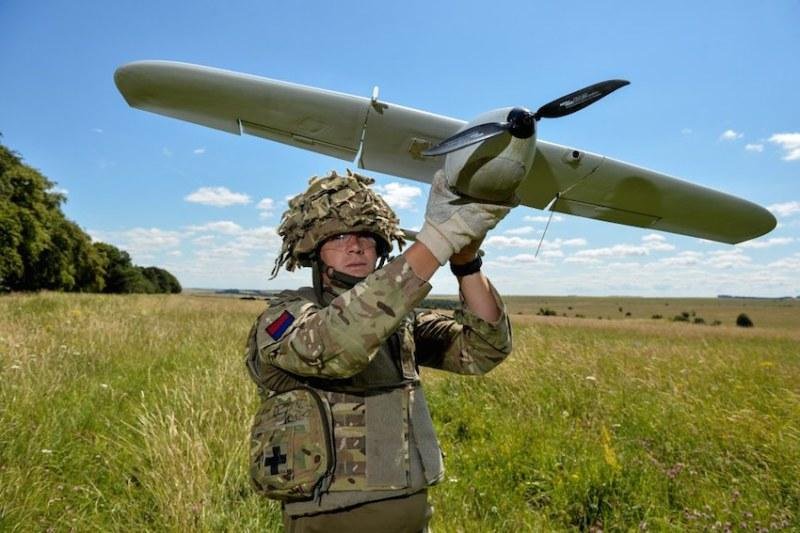
Given the hostilities in Ukraine following the invasion by Russia and now the conflict in the Middle East, the rapid evolution of satellite enabled drone technology is without doubt at the cutting edge of modern warfare. The pressure pot of war has accelerated the necessity for innovation and one-upmanship to stay ahead of one’s adversaries in our increasingly troubled world.
One aspect has remained constant, and that is the necessity for effective communications, as we have seen in a prime example recently where hostile Russian forces took advantage of the Starlink satellite communications network to improve their drone strike capabilities. Fortunately this has been curtailed by Elon Musk’s team at Starlink now they are aware of the situation, but it serves to demonstrate military applications of the technology that EnSilica (London: ENSI) is a leading specialist in.
Beamformer integrated circuits (ICs) are complex chips at the heart of communications between military devices (e.g. satellites, ground-based satellite user terminals, drones, combat vehicles etcetera) and it is beamformer ICs that the Russian’s have taken advantage of, by using potentially stolen Starlink user terminals to communicate with drones equipped with satellite enabled guidance and communications antenna.
While EnSilica is building a reputation for integrated circuits across a wide range of industries and applications, they have particular expertise and intellectual property in low-power, low-cost beamformer ICs. In my opinion this positions them well for not just the satellite payload and user terminal activities they are known to be engaged in, but potentially for drone antenna applications using their beamformer ICs also.
In addition to this, their European Space Agency funded work to produce a single chip to accommodate leading Global Navigation Satellite System (GNSS) algorithms may also lend itself well for drone navigation including potentially autonomous drones. Single chip GNSS receivers are commonplace in our smartphones, but these have lower requirements in terms of accuracy, reliability or resilience.
The chip in development by EnSilica is intended to be ‘for high-end GNSS receivers for uses such as surveying, drones, satellites, defence and the automotive industry, filling a gap in current European capability. The novel scaled-down chip design will offer benefits in efficiency and power, acquiring and tracking all current satellite and proposed low-Earth orbit navigation constellations on a dual-stream basis form separate radio antennas, delivering heightened resilience against GNSS spoofing and interference.’ In short it is intended to be cutting edge, sovereign European technology with a wide range of applications.
With all this in mind I suspect it won’t be too long before EnSilica announces its first pure-play defence contract, perhaps in connection with drone or uncrewed aerial vehicle technology. That’s why I think EnSilica is a potential sovereign defence gem hidden in plain sight.
Many thanks to u/Paraone3 🫶 for the inspiration for this post.
EnSilica: A Potential Sovereign Defence Gem Hidden in Plain Sight
by u/_DoubleBubbler_ in DoubleBubbler
